
 Building · Medication Timer
What I’ve been building over at Medication Timer, and why getting found is the hard part
A Medication Timer catch up: what shipped these past three months, what's next, and an honest look at evenings after my regular job, AI, and asking the people closest to me for a like, a share, or an intro.

If we haven’t caught up in a while: hi. I’m still in Adelaide, still building Medication Timer in the evenings after my regular job.
Three months ago the Medication Timer rebuild finally felt real. One Today screen for the household. My heart meds and INR in the same place as Jaxon’s asthma plan. Ericka and I looking at the same log instead of shouting “did you give it?” across the house. I wrote about why that rebuild happened.
Then I kept going, because once you trust the daily picture, the next gaps show up fast. This is what I’ve been shipping, who it’s for, and two things I’m excited about that aren’t quite finished: travel, and programming RFID coins from the app so a tap on the pack can do the jobs you already repeat.
Quick honesty up front. The app helps you remember who got what, and when. It does not invent doses. Follow your GP, your pharmacist, and the label.
Why Medication Timer exists (the short version)
Jaxon got sick. Then we all did. Paracetamol, ibuprofen, three people, notes that were already wrong. I was so scared of giving him too much that we almost certainly gave him too little. He sat with symptoms he didn’t need to sit with, because we couldn’t trust our own record.
Plenty of apps can start a timer. What we needed at 3 a.m. was simpler and harder: a shared picture, counted from when the dose was actually given.
Then my own health blew up. A murmur I nearly shrugged off. Open-heart surgery at the Royal Adelaide. A mechanical valve. The murmur gone, replaced with a rhythmic ticking. Warfarin for life. INR checks that belong next to the tablet, not in a different app. I came home tired, with weeks of recovery ahead. Ericka had to help. Jaxon still had preventers and a reliever. Then someone would bring a virus home from school and the whole house would go sideways again.
That’s the whole product, really. Fever nights and the everyday high-stakes stuff. As-needed medicines and scheduled ones are different jobs. Mix them up and families get hurt or under-helped. I wanted one place that doesn’t pretend they’re the same.
What I actually got done
I’m not going to walk you through every update. The release notes are there if you want them. Here’s what changed in our family, which is usually how I decide what to build.
Sick days finally live in one spot. We used to bounce between timers, temperatures, and “wait, what did the doctor say?” Care is the episode now: who’s unwell, what’s due next, last temp, notes you can dictate on the phone when you’ve only got one hand free. On Family Care you can run a short antibiotic course inside that same stretch, then it stops when the script stops. I also added the boring questions a GP actually asks after a stomach bug. Did they keep drinks down? Nappies? Sleep? Mood? You turn on only what you need. It’s a log, not a diagnosis. I’m glad it’s there. Those answers used to live in three people’s heads.
I got tired of unlocking the phone. If you’ve ever tried to log a dose while settling a child, you know. So the countdown and “what’s next” now sit on the home screen, the lock screen, Live Activities on iPhone, a persistent notification on Android, and an Apple Watch app. The Watch is early. Keep the iPhone nearby. But glancing at your wrist at 2 a.m. is a lot kinder than hunting for an icon.
Not every household wants the same first screen. Some of you are juggling a family. Some of you just want a calm as-needed timer and a temperature log. You can pick Family or Simple, hide tabs, put nicknames on people. Unlimited family members and medicines stay free. Family Care is the extra coordination: sharing, longer history, reports, those extra Care bits.
Real plans are weird, so the app had to get weirder. Nobody’s clinician writes “every day at 8:00” and calls it done. We now handle things like: stagger the second medicine you already space on purpose, and see who gave the last dose when two adults are on duty. A routine that fires after another one is actually logged. Monthly stuff, every-two-weeks stuff, “I logged this weekly reading a day early, please don’t nag me tomorrow.” Mark a bottle running low when you notice it, and keep a shared pick-up list so I don’t tell myself I’ll remember and then we hit the next fever with an empty cupboard.
Kids grow, and waiting rooms are chaos. I added growth charts (WHO and CDC) and body metrics for the rest of us. Take the charts to your GP. Don’t treat them as a diagnosis. I built them because I wanted to track my children’s development between doctor visits, not reconstruct it from memory in the waiting room.
Who I’m building this for
I keep saying this to people, so I’ll say it here.
I want one trustworthy picture for people living with health challenges, and for the people looking after them.
That’s bigger than “a dad made a fever app.” It’s also not “yet another pill reminder.” One person, same tablet every morning, phone alarm: that’s a solved-enough problem. The messy bit is households. Two adults. A child with asthma next to a parent on Warfarin. A grandparent who helps on Thursdays. A stomach bug on a Tuesday. A script that has to be finished. A clinic visit on Friday where you would rather hand over a report than a camera roll.
If that’s your life, this is for you. If you only need a box that beeps at 8 a.m., a pill organiser might be enough. Medication Timer is an app. It doesn’t dispense anything. I don’t sell your health data.
What other people have been saying
This still feels a bit unreal to write.
Families have logged nearly 40,000 doses, temperatures, and readings across 1,300+ people. That’s not a VC round. That’s households, many of them tired, tapping a thing I built. Family Care subscriptions are trending up too, which is a kind way of saying some of you wanted the shared picture enough to pay for it. Thank you.
A few lines from reviews on the site that I keep coming back to. They sound like our house, which is the whole point.
“This is great for tracking the family medication. No alarm to potentially wake you when asleep but a big green or red square to say yes or no for more medicine. Just what a sick parent needs when the whole family is ill.”
“I can never remember when I take cold medicine or allergy pills to know when I need my next dose. This simplifies it. Great app, and easy to use!”
“Thanks for making such a great app. It’s perfect to keep track of medications and also keeps track of the illness progression.”
“Great way to track medication for multiple family members.”
If you’ve left a review: I read them. They change what I build next.
What’s next for Medication Timer
One of my ongoing objectives is to continue to remove the friction that families face when managing their health and medication routines.
Travel. I love travelling. I love visiting new countries. I also now have a rigid medicine routine. Warfarin does not care that you boarded a long-haul flight. Phones are quietly awful at this. “8:00 am” suddenly means a different 8:00 am, or you end up with a notes-app spreadsheet at the gate.
There’s an experimental travel mode in the app now. It’s early. The idea is:
- Put your long flight or travel plans into the app
- Sit with your GP or pharmacist
- Look at how the clocks jump
- Agree any dose extras or skips with them
- Save it for that trip only
The app does not invent a destination plan. If Ericka stayed home and I took Jaxon somewhere, she can still see us in travel mode, and she can mute the destination-hour pings so a New York morning doesn’t wake the Adelaide bedroom.
RFID coins. We’re not making the coins. You can already buy cheap NFC tags. What we’re adding is the ability to program them from Medication Timer for the jobs you do over and over.
Stick one on a pack. Hold the phone to it. Confirm. Same log as if you’d tapped in the app. You can bind the details up front, or leave them blank and answer at tap time.
Common tasks we’re aiming for:
- pull up that medicine’s details, then log from there
- mark a scheduled dose as taken
- log an as-needed dose
- start a quick timer
- mark overdue routines as taken
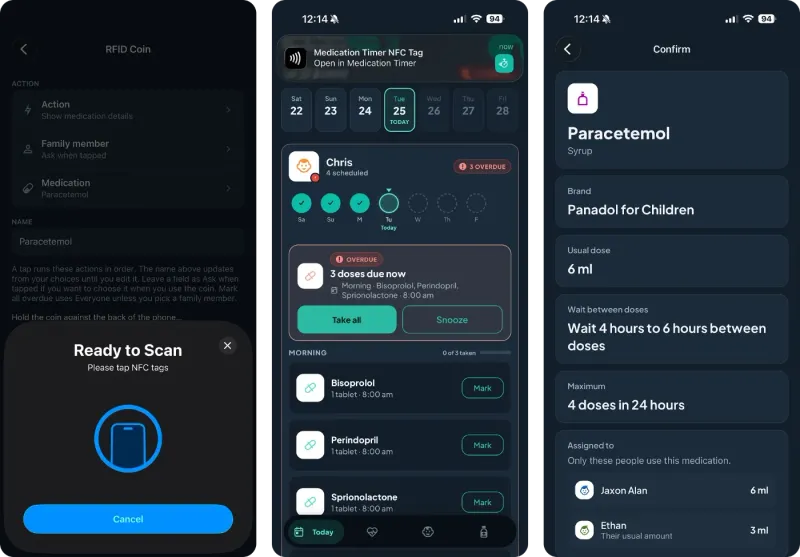
Ultimately this is about better supporting people with health challenges. Have you tried to read the dosage instructions on your medicines lately? Tiny print, foil glare, a morning when your eyes or your hands or your energy aren’t cooperating. Being able to tap a tag to mark a routine dose as taken, or even just to see what that medicine is, is a real improvement when you’re struggling. The phone still has to be there, and we still ask you to confirm. We’re not inventing the dose. We’re trying to make the next honest action easier.
I’m testing this update now. It should land in the coming weeks.
Trying to get found without losing the plot
Building the thing is the part I know how to do. Getting anyone to hear about it, without turning into a different kind of company, is the part that keeps me up.
The market doesn’t care about the reasons I built it. The well-funded reminder apps can buy ads. They show up in every roundup because they already show up in every roundup. Medisafe, MyTherapy, the platform health hubs: they have brand, backlinks, review volume, and teams whose job is discovery. I’m a sole trader in Adelaide. I can’t outspend them. I also won’t put ads in the product, and I won’t sell health data to fund the ads I can’t afford. That’s a principle, and it’s also a growth disadvantage. I’m not pretending otherwise.
Then there’s Google. You don’t really “do SEO” as a side hobby. You feed an algorithm that prefers what’s already famous, already linked, already phrased the way a thousand other pages are phrased. Health queries are extra twitchy, which is fair, and also means a small independent app can write something true and still sit under ten listicles that haven’t been updated since 2022. The App Store and Play Store have their own versions of the same game. Rankings love what already ranks. Featured slots love what’s already featured.
I have experimented with AI tools to publish consistently for visibility and rankings. That’s not a secret, and if you’ve spent five minutes on medicationtimer.com you can probably tell. Comparison posts, how-tos, the same household problem said sixteen ways so Google might notice. I don’t have a content team. I have evenings after my regular job: to work on the app, plus trying to keep socials and articles going. The algorithm wants volume and keywords. Some of those pages are useful. Some of them sound like a machine trying to be a dad. I’m not proud of the ones that miss. I’m also not going to pretend I wrote every sentence by hand when I didn’t.
The risk isn’t just wasted evenings. It’s drifting. I don’t want the algorithm to shape the product. I want the product to evolve from real household gaps, then find a way to talk about that for search. Otherwise I slowly sand off the parts that don’t fit a keyword. That’s the work I actually believe in, and it’s the easiest work to abandon when you’re trying to get found.
So this is the honest bit, if you’re a friend or a connection reading this: I don’t have a clever growth hack. I have households already using it, a story I can tell without lying, and a stubborn need not to become a generic reminder app just because that’s what ranks.
The other hard part, and I don’t love saying it, is that support can be thinnest from the people who care the most. I get it. We’re all busy. Kids, work, our own health, the group chat that never ends. When you’re doing this solo, though, a like, a share, or an introduction is not a small thing. It takes a minute. It tells an algorithm, and a stranger, that a real person thinks this is worth a look. Silence is easy to read as “maybe it isn’t.”
If you know someone this would have helped on a bad night, send them the link. That kind of awareness is slower than an ad account. It’s also more meaningful to me than boosting an Instagram post.
Medication Timer is designed to be useful for free, because that’s the right thing to do. Unlimited family members, unlimited medicines. Family Care is there when you need sharing and depth, not as a lock on the basic features that a household would use.
Download Medication Timer today